
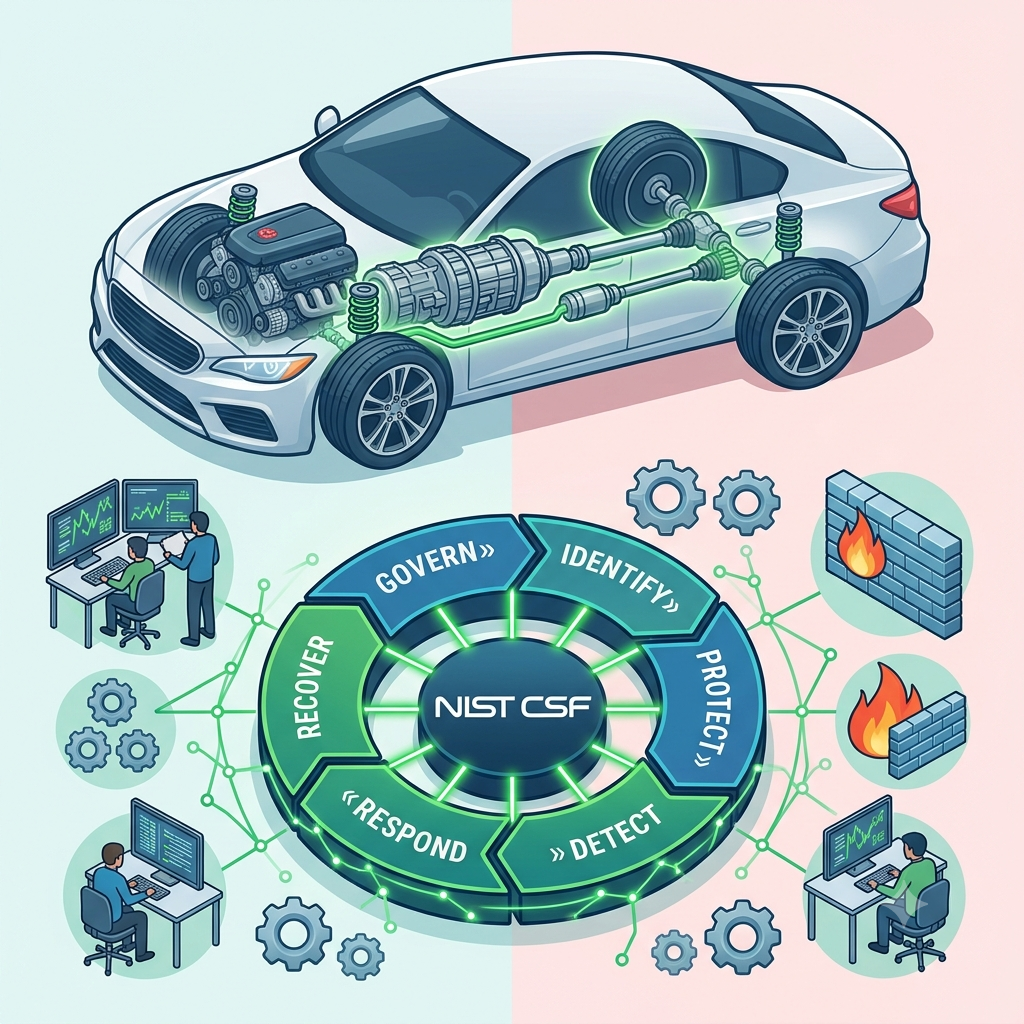
Imagine a small car manufacturer that says:
“We’re small, and we don’t have any skill in transmissions — so we just won’t build them.”
The car might look fine from the outside. It might have doors, seats, windows, and a steering wheel. But it won’t function. It won’t move. It won’t serve its purpose.
This is exactly what happens when small organizations skip parts of the NIST CSF because they feel “too small” or “too limited” to implement them.
Cybersecurity is a system. Every outcome contributes to the whole. Skipping outcomes breaks the system.
Small organizations often say:
- “We don’t have monitoring skills — so we’ll skip it.”
- “We don’t have governance expertise — so we’ll skip it.”
- “We don’t have incident response staff — so we’ll skip it.”
But skipping outcomes doesn’t make the risk disappear. It just makes the organization vulnerable.
The issue isn’t that NIST CSF “doesn’t apply.” The issue is that small organizations need to implement the outcomes differently:
- Outsourcing instead of building internally
- Simplifying instead of over‑engineering
- Prioritizing instead of trying to do everything at once
- Using cloud‑native controls instead of custom infrastructure
- Leveraging external responders instead of internal teams
A car without a transmission isn’t a car. A cybersecurity program without core outcomes isn’t a cybersecurity program.
Small organizations don’t need to be large — they need to be complete.
