
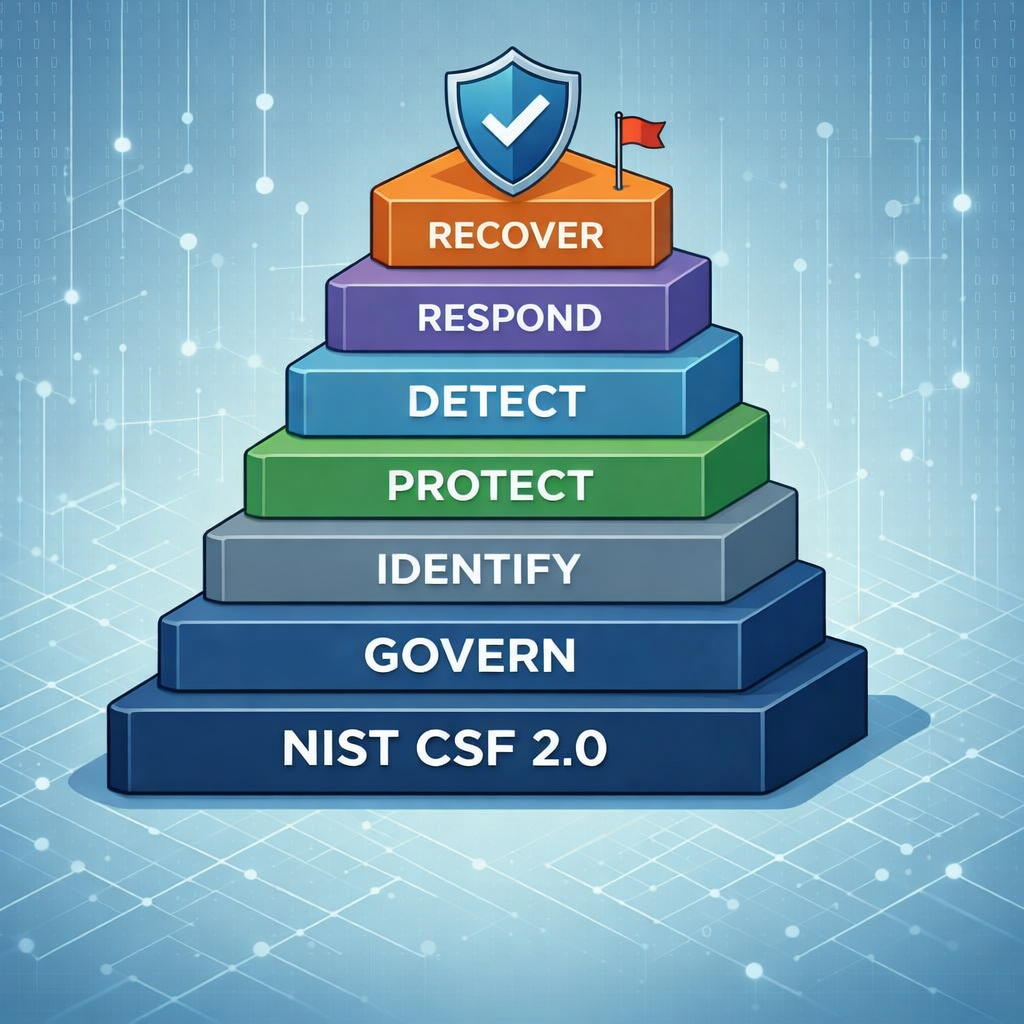
Organizations everywhere are adopting NIST CSF 2.0 — not because it’s new, but because it’s practical. It provides a structured, comprehensive, and business‑friendly way to understand cybersecurity risk. And in a world where cyber threats evolve faster than budgets, clarity is everything.
NIST CSF 2.0 organizes cybersecurity into six core functions: Govern, Identify, Protect, Detect, Respond, and Recover. These functions break down into 22 categories and 106 subcategories, each representing a measurable cybersecurity outcome.
This structure gives organizations a way to understand cybersecurity maturity without drowning in complexity.
Why Organizations Choose NIST CSF 2.0
- It’s outcome‑based, not tool‑based. NIST doesn’t tell you what product to buy — it tells you what capability you need.
- It’s flexible. Small organizations, mid‑market companies, and enterprises can all use it effectively.
- It aligns with other frameworks. ISO, SOC 2, CIS, and other standards map cleanly to NIST.
- It supports maturity‑based decision‑making. You can measure where you are, where you want to be, and how to get there.
- It’s leadership‑friendly. Executives can understand the structure without needing technical depth.
The Power of the GOVERN Function
One of the most impactful elements of NIST CSF 2.0 is the GOVERN function. It emphasizes:
- Organizational context
- Roles and responsibilities
- Policy expectations
- Supply chain risk
- Oversight
These are the areas where organizations often struggle — and where maturity gaps create the greatest risk.
Why NIST CSF Works So Well with CyberDynamX
The CyberDynamX Assessment Program uses NIST CSF 2.0 as its foundation because it provides:
- A complete view of cybersecurity
- A consistent scoring model
- A defensible maturity baseline
- A structure that executives can understand
- A way to prioritize improvements using the Matrix
NIST CSF 2.0 gives organizations clarity. CyberDynamX turns that clarity into action.
Want this kind of visibility? Check out the Assessment: The Assessment
