
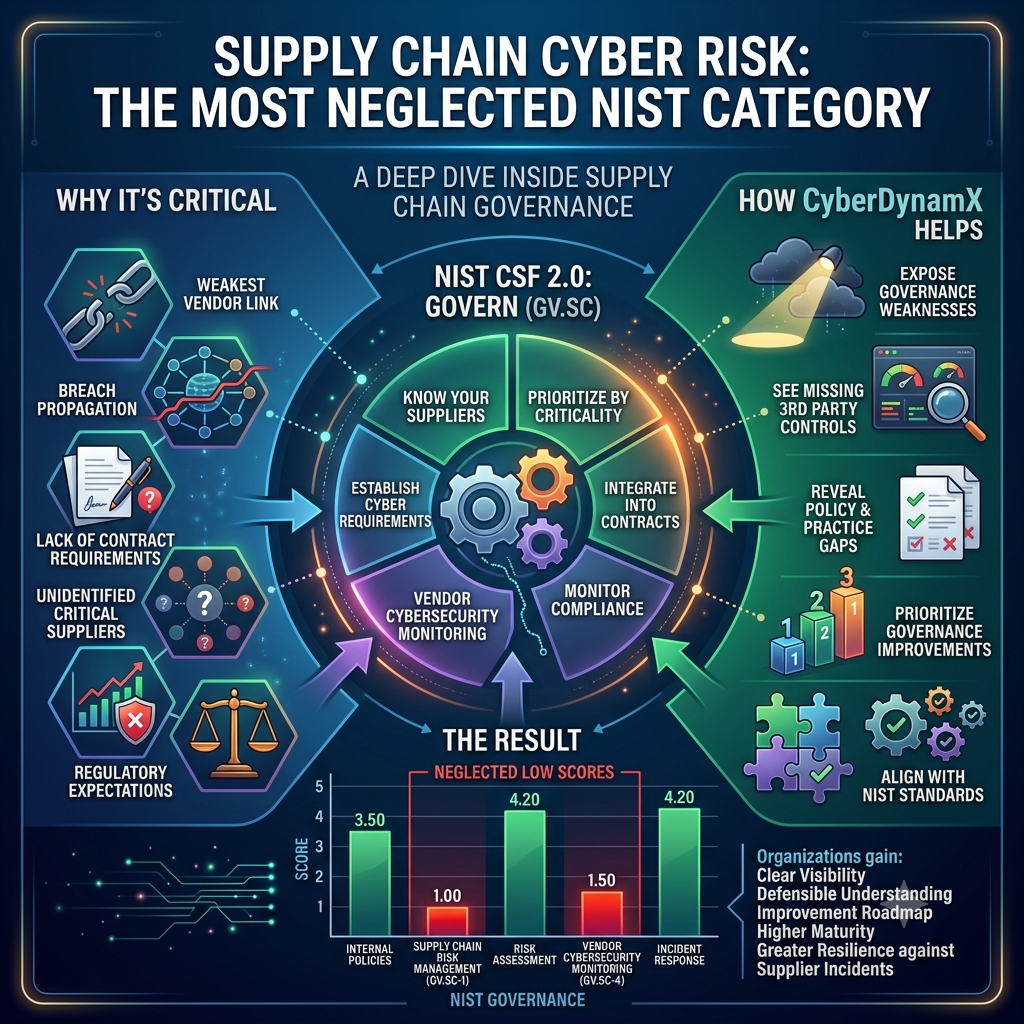
Supply chain cyber risk is one of the most overlooked areas in cybersecurity — and one of the most dangerous. Organizations depend on vendors, partners, cloud providers, and third‑party services more than ever. Yet many have no formal process for evaluating or managing the cybersecurity risks those suppliers introduce.
In the Curtis Company example, supply chain categories scored extremely low — as low as 1.00.
Why Supply Chain Risk Is So Critical
- Your security is only as strong as your weakest vendor. A breach in a supplier can become a breach in your organization.
- Contracts often lack cybersecurity requirements. Without clear expectations, vendors operate without accountability.
- Critical suppliers may not be identified. Organizations often don’t know which vendors pose the greatest risk.
- Third‑party incidents are rising. Attackers increasingly target supply chains because they’re easier to compromise.
- Regulators are paying attention. Supply chain oversight is becoming a compliance expectation.
What NIST CSF 2.0 Requires
The GOVERN function includes:
- Knowing your suppliers
- Prioritizing them by criticality
- Establishing cybersecurity requirements
- Integrating those requirements into contracts
- Monitoring compliance
Most organizations struggle with all of these.
How CyberDynamX Helps
(Rewritten to reflect reality and strengthen your positioning)
CyberDynamX does not manage vendors or rewrite contracts — and it doesn’t pretend to. What it does is far more foundational: it exposes the governance weaknesses that make supply chain risk invisible.
Using NIST CSF 2.0 as the backbone, CyberDynamX helps organizations:
- See where third‑party governance is missing or incomplete The Matrix highlights gaps in supplier identification, criticality ranking, contract expectations, and oversight.
- Understand which supply chain controls are required — and which are absent Organizations often discover they have no formal process for onboarding vendors, assessing risk, or defining cybersecurity obligations.
- Reveal inconsistencies between policy, practice, and reality Even mature organizations find that their vendor management processes are informal, undocumented, or not followed.
- Prioritize the most important governance improvements The scoring model shows exactly where to focus first — whether it’s supplier inventory, contract language, or monitoring.
- Align third‑party governance with NIST CSF 2.0 expectations The program maps each gap to the specific NIST subcategory, making remediation clear and defensible.
CyberDynamX doesn’t replace vendor management. It strengthens the governance that makes vendor management possible.
The Result
Organizations gain:
- Clear visibility into supply chain weaknesses
- A defensible understanding of third‑party risk
- A roadmap for improving contracts and oversight
- Higher maturity scores
- Greater resilience against supplier‑driven incidents
Supply chain risk is too important to ignore — and too dangerous to leave unmanaged.
