
Cyber governance is essential — but most governance programs fail. Not because organizations don’t care, but because their governance frameworks become too large, too complex, and too disconnected from real‑world operations.
Governance collapses when it becomes unmanageable.
The CyberDynamX Governance Enablement Program solves this by taking a targeted, surgical approach. Instead of overwhelming organizations with hundreds of pages of documentation, it focuses only on the governance elements that materially improve clarity, reduce risk, and support audit readiness.
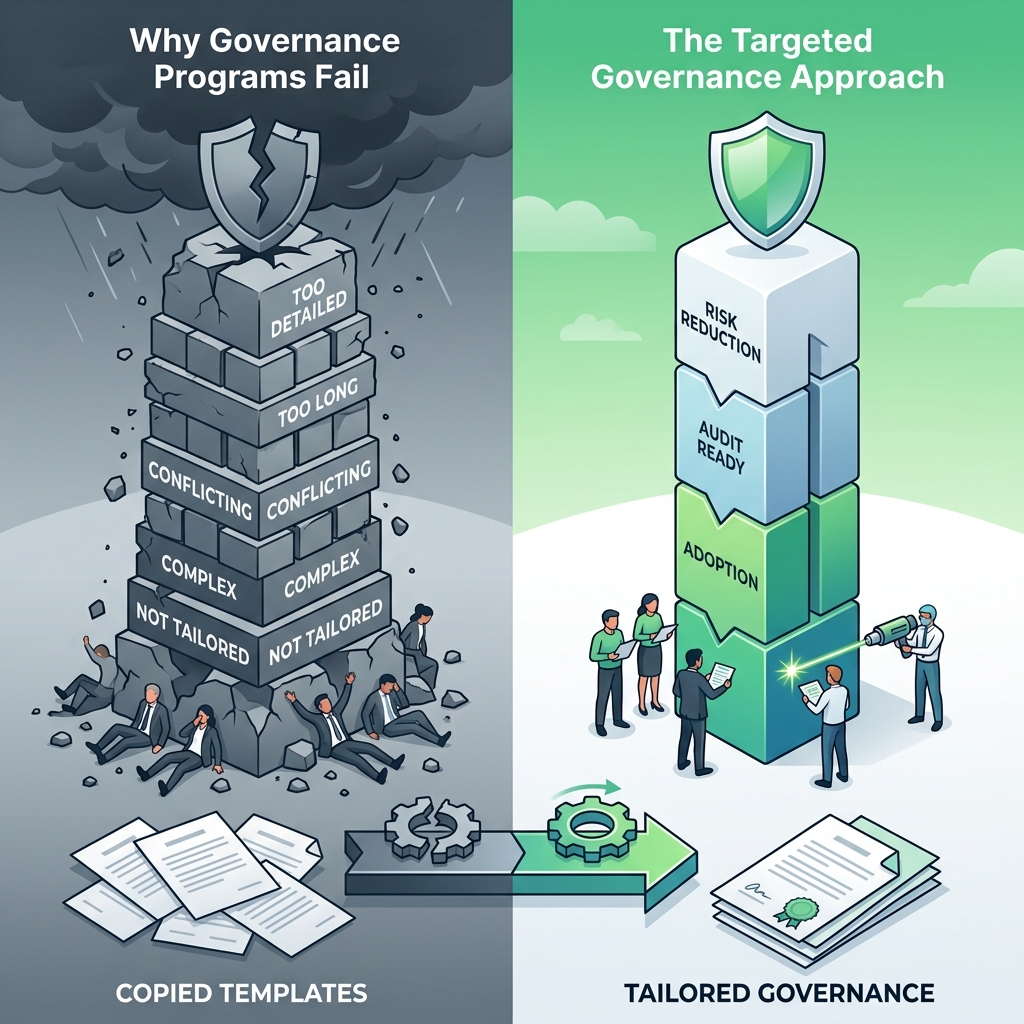
Why Governance Programs Fail
Governance programs often collapse because:
- Policies are too long
- Standards are too detailed
- Procedures are too complex
- Baselines are missing
- Documents conflict with each other
- Templates are copied from the internet
- Governance is not tailored to the organization
- Implementation support is missing
This creates confusion, friction, and resistance.
The CyberDynamX Approach: Surgical, Not Exhaustive
The Governance Enablement Program focuses on:
- What matters most
- What reduces risk
- What supports audit readiness
- What aligns with NIST, ISO, and SOC 2
- What organizations can actually adopt
This ensures governance is powerful — not overwhelming.
Why Targeted Governance Works Better
Targeted governance:
- Reduces friction
- Accelerates adoption
- Strengthens alignment
- Improves audit readiness
- Supports maturity growth
- Eliminates unnecessary complexity
Organizations get exactly what they need — no more, no less.
How CyberDynamX Supports Implementation
The program includes:
- Tailored policies
- Targeted standards
- Practical procedures
- Actionable baselines (Tier 3)
- Governance walkthrough sessions
- Advisory consulting days
- Traceability matrices (Tier 3)
- Board‑level security overview decks (Tier 3)
This ensures governance is implemented effectively.
The Result
Organizations gain:
- Clear expectations
- Strong alignment
- Reduced ambiguity
- Better audit outcomes
- Sustainable governance
Governance becomes a foundation — not a burden.
How’s your cyber governance? Get The Assessment and find out.
