
Identifying your highest‑risk cybersecurity gaps shouldn’t require weeks of analysis and a small army of consultants. The reality, though, is that most organizations struggle to see where their real exposure lies. They have reports, dashboards, and metrics—but not a clear, prioritized view of what actually needs attention first.
That’s exactly what the CyberDynamX Matrix is designed to solve.
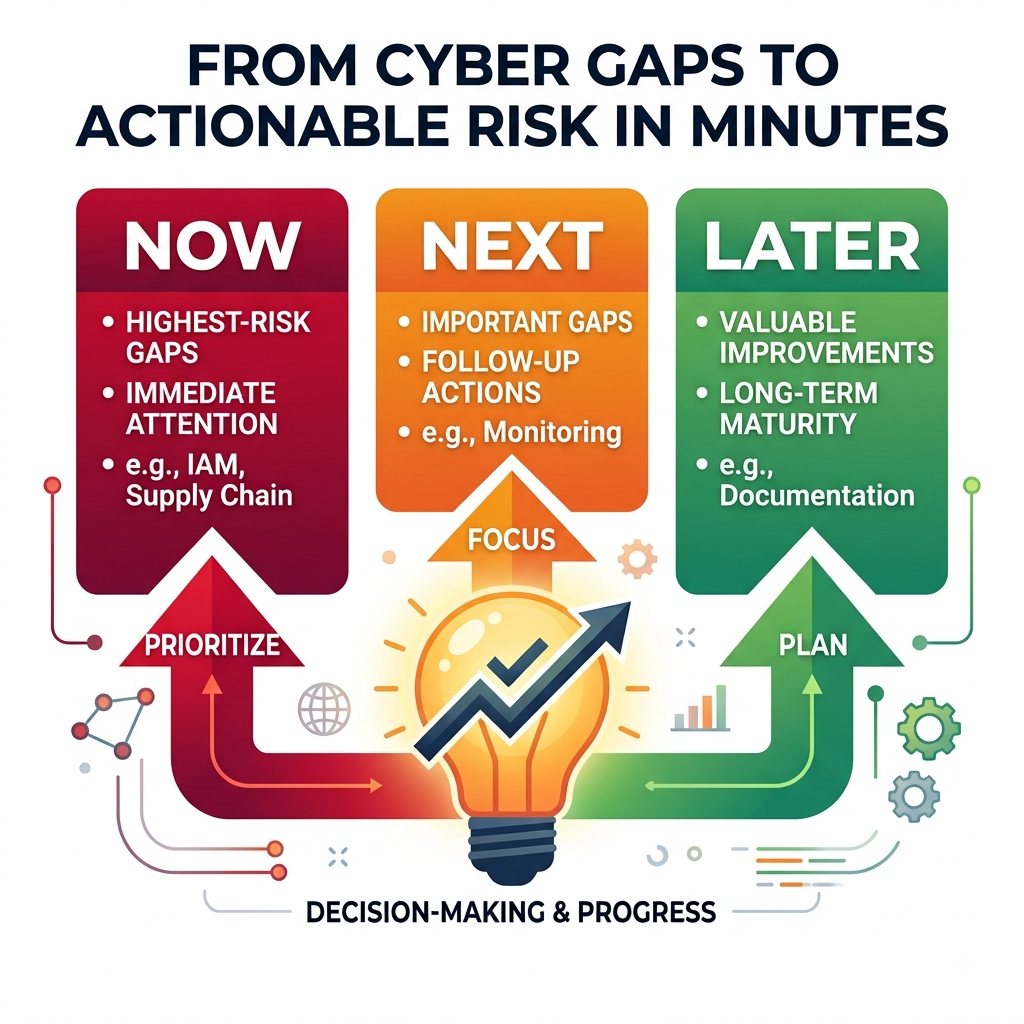
The Matrix takes the full breadth of your cybersecurity assessment—mapped to NIST CSF—and distills it into a single, risk‑based view. Instead of combing through dozens of pages, you can see your lowest‑maturity items, grouped into NOW, NEXT, and LATER, in minutes.
It’s not just efficient—it’s transformative.
From Scores to Risk: Making Maturity Actionable
Every question in the CyberDynamX Assessment Program is scored against a maturity scale. Those scores tell you how defined, consistent, and proactive your cybersecurity practices are.
Low maturity scores typically indicate:
- Incomplete or informal processes
- Reactive rather than proactive behavior
- Inconsistent implementation across teams or systems
- Lack of documentation, measurement, or enforcement
These aren’t just “areas to improve”—they’re risk indicators.
The Matrix takes these indicators and turns them into a visual, prioritized map of where your organization is most exposed.
How the Matrix Identifies High‑Risk Gaps
The process is straightforward but powerful:
- Assess all relevant NIST CSF subcategories Your organization completes a structured self‑assessment aligned to NIST CSF, covering all core functions: Govern, Identify, Protect, Detect, Respond, and Recover.
- Calculate maturity scores for each subcategory Each subcategory receives a maturity score, revealing how well that specific outcome is being achieved.
- Highlight the lowest‑maturity items Subcategories with the lowest scores are flagged as potential high‑risk gaps. These often include areas like:
- Supply chain cybersecurity requirements
- Identity and access management
- Continuous monitoring
- Incident mitigation and recovery
- Organizational context and roles
- Group them into NOW / NEXT / LATER
- NOW: Highest‑risk gaps that require immediate attention
- NEXT: Important gaps that follow once NOW items are underway
- LATER: Valuable improvements that support long‑term maturity
- Present everything on a single page The Matrix shows all of this in one view—no scrolling, no hunting, no guesswork.
In minutes, leaders can see exactly where the organization is most vulnerable and what needs to happen first.
Why This Matters for Leadership
Executives don’t have time to interpret raw data. They need:
- A clear picture of risk
- A defensible prioritization model
- A way to connect cyber gaps to business impact
- Confidence that resources are being directed to the right places
The Matrix gives them that.
Instead of asking, “Where should we start?” leadership can ask, “Are we moving fast enough on our NOW items?” That’s a very different conversation—and a much more productive one.
Turning Insight Into Action
The CyberDynamX Assessment Program doesn’t stop at identification. Each high‑risk gap is supported by:
- Clear, actionable recommendations
- Context on why the gap matters
- Guidance on how to close it
- Roadmap alignment in higher tiers (e.g., risk‑based cybersecurity roadmap)
This means you’re not just seeing the problem—you’re seeing the path forward.
The Real Value: Speed and Confidence
Being able to identify your highest‑risk cyber gaps in minutes isn’t just a convenience—it’s a strategic advantage.
You gain:
- Speed: Faster understanding, faster decisions, faster action
- Focus: Effort directed where it reduces risk the most
- Alignment: IT, security, and leadership working from the same picture
- Confidence: A defensible, evidence‑based view of risk and maturity
The Matrix turns maturity scoring into a decision‑making tool—and that’s where real progress begins.
Get the Assessment with the Matrix: The Assessment
