
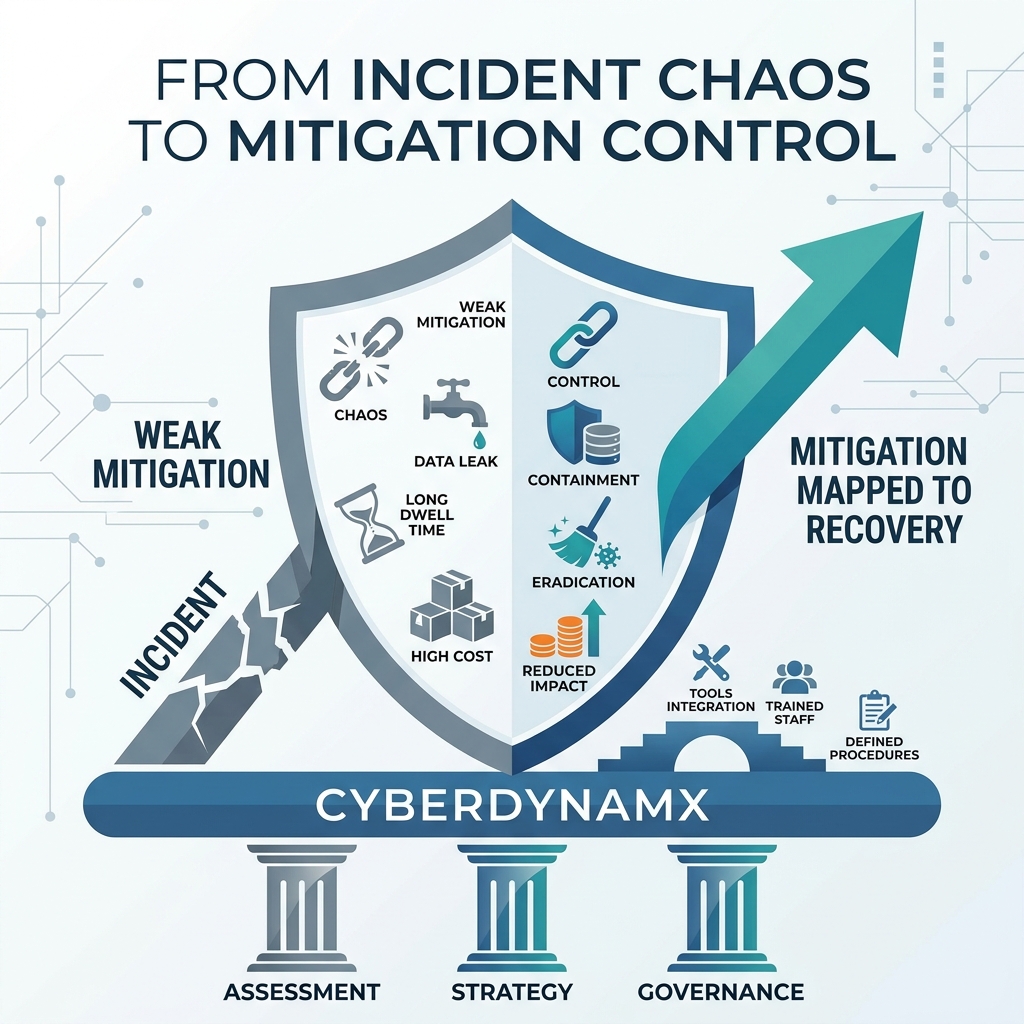
Incident mitigation is one of the most critical cybersecurity capabilities — and one of the most commonly underdeveloped. In many assessments, organizations score 1.00 in this category, indicating reactive, incomplete, or nonexistent processes.
This is dangerous.
Incident mitigation determines whether an incident becomes a minor disruption or a major breach.
Why Incident Mitigation Scores Are Low
Organizations often struggle with mitigation because:
- Roles are unclear
- Procedures are missing
- Containment steps are undefined
- Eradication processes are inconsistent
- Staff are not trained
- Tools are not integrated
- Response plans are outdated
These gaps create significant exposure.
What NIST CSF Requires
The Incident Mitigation category (RS.MI) includes outcomes such as:
- Containing incidents
- Eradicating threats
- Preventing further harm
- Coordinating mitigation activities
- Ensuring timely action
These are essential for reducing impact.
The Consequences of Weak Mitigation
Weak mitigation leads to:
- Longer dwell time
- Greater data exposure
- Higher recovery cost
- Increased operational disruption
- Larger reputational damage
- Regulatory consequences
Mitigation is the difference between control and chaos.
How CyberDynamX Helps Improve Mitigation
The CyberDynamX Assessment Program identifies mitigation gaps with precision. The Matrix highlights mitigation subcategories that fall into the NOW tier.
The Governance Enablement Program supports mitigation maturity by providing:
- Incident response procedures
- Incident management standards
- Logging and monitoring standards
- Recovery execution guidance
- Advisory support for implementation
This creates a complete mitigation improvement path.
The Result
Organizations gain:
- Faster containment
- Stronger eradication
- Reduced impact
- Higher resilience
- Better maturity
Incident mitigation becomes a strength instead of a vulnerability.
Get the Assessment: The Assessment
