
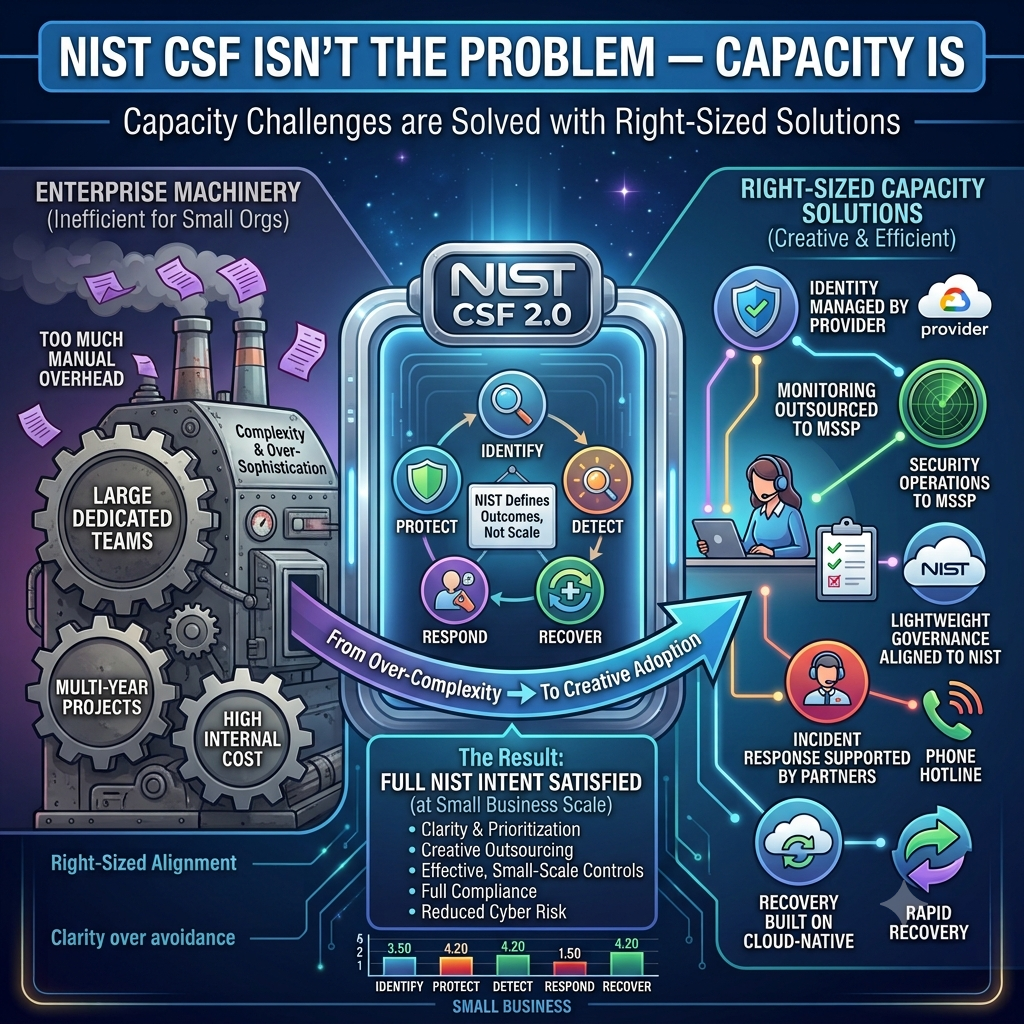
Small organizations often claim that NIST CSF “doesn’t fit” their environment. But when you look closely, the issue isn’t the framework — it’s capacity.
NIST CSF defines what good cybersecurity looks like. It doesn’t prescribe how big your team must be, how sophisticated your tooling needs to become, or how complex your processes must appear. It defines outcomes, not scale.
Large enterprises reach those outcomes through specialization and internal resources. Small organizations reach them through simplification, outsourcing, and right‑sized governance. The path is different — but the expectations are the same.
Where small organizations struggle is in assuming NIST requires enterprise‑level execution. It doesn’t.
Examples of right‑sized alignment include:
- Identity managed by a provider
- Monitoring outsourced to an MSSP
- Lightweight governance aligned to NIST CSF 2.0
- Incident response supported by external partners
- Recovery built on cloud‑native capabilities
These approaches fully satisfy NIST’s intent.
Capacity challenges require creativity, not avoidance. Small organizations don’t need enterprise machinery — they need clarity, prioritization, and the willingness to adopt controls that match their size.
NIST CSF isn’t the barrier. Capacity is — and capacity can be solved.
